
Taking the World Stage: Echoes of the Bay Earns International Acclaim at Ars Electronica 2026
Joining the Global Community of Ars Electronica
At the 2026 Ars Electronica Festival, the world’s premier stage for media art and digital transformation, the Culture Futures Lab at LASALLE College of the Arts made an unforgettable mark. In collaboration with VR Artist Benedict Yu BA Arts Management Programme students designed a flagship virtual reality installation Echoes of the Bay that captured global acclaim, securing a prestigious Honorable Mention in the festival’s celebrated Campus Exhibition hosted at the University of Arts Linz.
Originally co-funded by the Ministry of Culture, Community and Youth’s Our Singapore Fund to commemorate Singapore’s 60th year of independence, Echoes of the Bay re-envisions archival practice by transforming heritage from a static historical repository into a living, participatory dialogue. The installation features a triple-modality architecture: a serenely rendered "Virtual Archipelago" where visitors navigate sixty co-authored digital "story-boats" to experience intimate oral testimonies, an interactive "Shipyard" enabling audiences to sculpt their own migration narratives in real time, and "The Letter Boat," a tangible bridge showcasing handwritten reflections.
By countering algorithmic fragmentation and elevating minoritized knowledge, the project serves as a vital infrastructure for negotiation, directly embodying the Ars Electronica 2026 theme, NEGOTIATING HUMANITY. In an era where artificial intelligence threatens to reduce human experience to automated data points, Echoes of the Bay reasserts the "resilience of being human" through its deeply relational design. By pairing digital world-building with physical "Letter Boats" carrying handwritten testimonies, the installation transforms virtual reality from an instrument of isolated consumption into an intermediate space for productive ambiguity, empathy, and collective self-transformation. Receiving an Honorable Mention validates the Culture Futures Lab’s achievement in demonstrating how technology—when guided not by automated efficiency, but by an ethic of care and shared stewardship—can function as a democratic toolkit to continuously renegotiate our collective identity, spatial memory, and human connection.
What Happens When We Choose to Wander? Redefining the Festival Experience at Ars Electronica by Angela Kristie Rustham
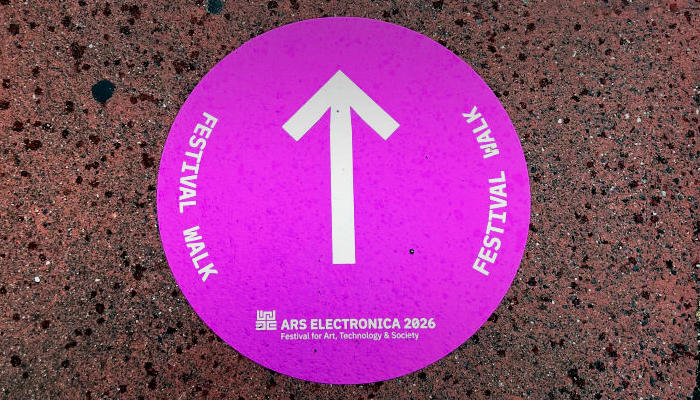
Two encounters on my last day at Ars Electronica transformed how I understand festival management, revealing that a festival’s true impact does not just live on its main stage, but through the unexpected paths we walk and the connections we make when we simply choose to explore. Ars Electronica’s sheer scale is indeed mind blowing: the festival spans dozens of venues across the city, hosting hundreds of exhibitions, installations, performances, and conferences that draw tens of thousands of international visitors and featured artists worldwide. It is impossible for anyone to cover every single offering; no single attendee can ever experience it in its entirety, leaving a deep feeling that there is always another discovery waiting just beyond the corner. Squeezed between exhibition shifts, my junior and I set off on what should have been a brief 15-minute walk from OK Platz to the MED Campus. Instead, this journey stretched into a 1.5-hour immersion that became a joyful way to explore both Linz and the festival's expansive footprint. Following signboards into churches, community spaces, and local schools, we were captivated by how decentralized programming transforms the urban landscape into a living canvas—sparking curiosity at every corner and demonstrating how masterfully managed urban arts infrastructure can turn an entire city into a stage for discovery.
Yet, amid the overwhelming scale and technological brilliance of the festival, it was these unscripted, human encounters that left the most indelible impression. At the University of the Arts Linz Campus exhibition, I met Paria Dayyani, co-creator of the Campus Award Honorary Mention piece [un]finished carpet, when she visited our VR installation to sculpt her own "story-boat." In a genuine exchange of artistic perspectives, she later invited me to her team’s Deep Space 8K prototyping studio—an intimate, experimental space where students across disciplines test interactive projections before taking them to the main stage. While missing the official Deep Space 8K program at the Ars Electronica Center initially felt like a missed opportunity, gaining these behind-the-scenes insights directly from Paria and her team proved far more rewarding. Beyond technical learning, this encounter demonstrated how thoughtful festival curation builds more than just platforms for display; it fosters authentic, peer-to-peer global dialogue.
On a Scale of 1-10, How Would You Rate Humanity? Lessons from Ars Electronica by Amila Khairana Binte Abdul Rahmat
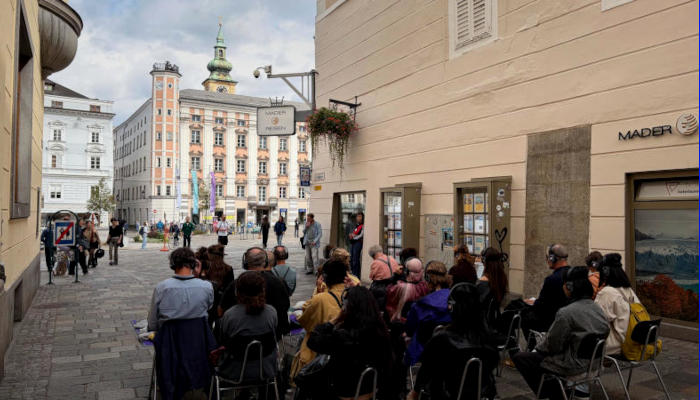
Attending Ars Electronica offered an opportunity to reflect on the evolving intersection of technology, culture and human experience. Among the festival’s diverse program, Reality Screenshot by Eléctrico 28 and Domestic Data Streamers stood out as one of the compelling highlights. The performance ingeniously blended street theatre with real-time data visualisation, addressing how rapid information is processed and consumed in today’s current AI-centric world. By having performers deliver live, humanised updates on immediate surroundings paired with analytical data, the work delivered an eccentric yet poignant critique of the modern digital saturation. It was concluded in a thought-provoking question to the audience: “On a scale of 1-10, how would you rate humanity?”
This made me realise how seamlessly interactive art could dismantle passive observation. It changed my understanding of festival-making, showing that technology in the arts should not be a mere spectacle but can be used as a tool to interrogate and educate our societal choices. It forced me as a viewer to step out of my comfort zone, evaluate my own biases and consider what we must and truly value in an automated world. Engaging with the festival’s central theme: Negotiating Humanities, expanded my perspective on the ethical responsibilities in the tech age. It validated the thought that it must continually provoke meaningful reflection on human agency, empathy and collective responsibility.
Expect the Unexpected: A Wake-up Call at Ars Electronica by Shernice Sah Jia Yi
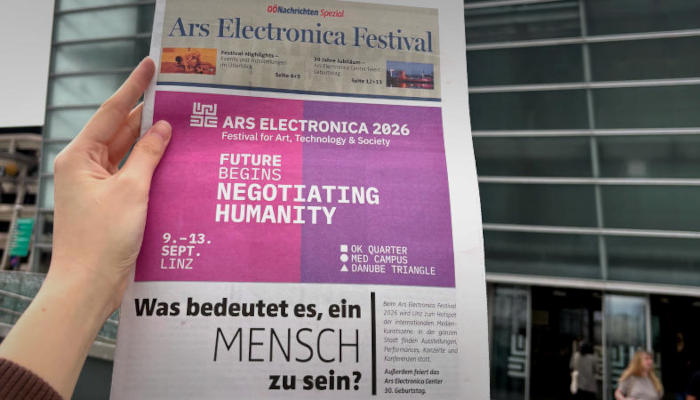
Ars Electronica feels like time brought to a standstill, a temporary hold on the status quo where we gather to debate what is truly essential for our shared future.
Wandering through the festival Campus Exhibition, my perception of how art can communicate was completely shattered by Dare Not to Know by Monika Machutova. The interactive installation delivers a literal electric shock to your fingers whenever you select an incorrect answer to questions regarding topics like gender-based violence and basic human rights. I never imagined art could be framed as a physical punishment for ignorance. It served as a wake-up call, transforming passive knowledge into a sharp, bodily reminder of the real-world severity surrounding these issues. The work proved that getting a message across doesn't always require words; sometimes, it requires a bold disruption that breaks through our collective numbness.
This experience taught me to expect the unexpected. Moving forward, my goal as a creator is not to experiment within comfortable boundaries or rely on familiar formats, but to push past what is safe. Ars Electronica highlights that shaping an ethical, humane future requires asking hard questions: What essential topics are we turning a blind eye to? What could we have done differently? The future is not certain, but it remains in our hands to make it safe, purposeful, and fair. By confronting our blind spots through unapologetic, boundary-pushing art, we take a necessary first step toward making choices that honor human dignity above all else.
Bridging Technology and Touch: A Lesson from Ars Electronica by Vina Tan Ding Kiang
Attending Ars Electronica reshaped my understanding of how art seamlessly bridges STEM and humanitarian fields, serving as an unmatched storytelling medium for complex, technical subjects. Immersive installations reflecting on our past, present, and future highlighted how deeply art influences perspective and decision-making by anchoring rapid technical innovation to core human values. A major turning point for me was overcoming my initial skepticism toward artificial intelligence. Seeing the rising number of artists using AI to enhance creativity while maintaining their core vision and artistic integrity completely changed my perspective. While the integration of AI in artwork may be an inevitable future, the artists here demonstrated how to adopt these tools thoughtfully, ensuring the work never feels artificial or "cringe," but instead retains an authentic human touch. This experience reinforced my interest in digital art, while clarifying a fundamental truth. Digital art can never rely on technology alone; it strictly requires an element of human connection to be impactful.
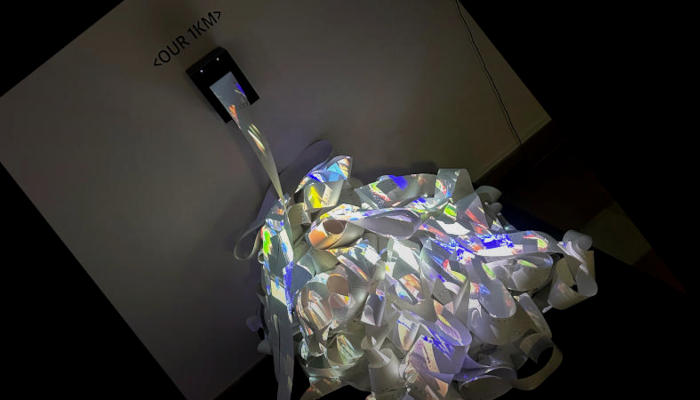
Cartography of a Genocide, one of the winning pieces featured at the festival was a sample of this. The work presents data on casualties from the Gaza conflict in various forms. As a politically sensitive piece, its impact stems from its courage in laying bare uncomfortable truths. It broadened my appreciation for art as a bridge for discussing complex global issues, serving as a stark reality check beyond headlines and official narratives. Another work that left a lasting impression was Disappearance of Rituals, specifically 1KM. The installation prompted me to reflect on my screen time and consider what I could accomplish with those lost hours. Though the concept addressing the severity of doom scrolling was simple, the execution was highly engaging and participatory. Visitors scrolled through a makeshift social media interface while the system tracked their time. Upon exiting, it printed a physical receipt where every second spent was converted to 0.5 centimetres of paper, giving a tangible form to wasted time. Both works resonated with me not because of their physical scale but because they paired technology with a human element. Each was designed with a clear intention to raise awareness of our shared flaws and prompt meaningful self reflection. And that to me, the intentionality, is the very definition of a human touch in art.
From Screens to Scents, From Cables to Roots by Muhammad Haris Bin Muhammad Shahril
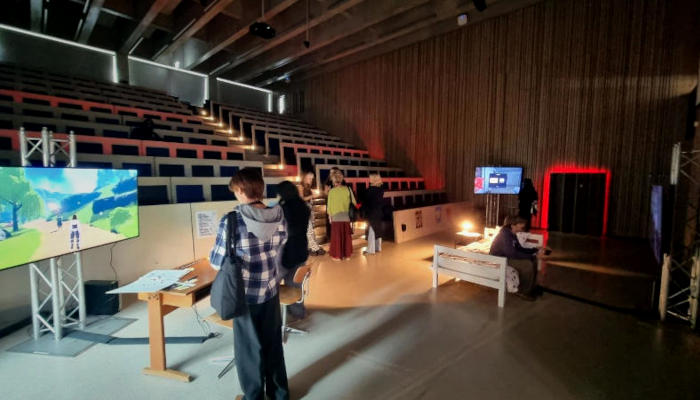
Ars Electronica was filled with so many wonders and so much life that it radically changed my perspective. It showed me how immersive media and contemporary festivals can stage socio-political critique. There were two installations that bewildered my personal experience: Radical Gaming and Olfactory Biome. As someone who spends a lot of his time online through different gaming communities, Radical Gaming by Linz Institute of Technology spoke powerfully to me. It exposes the hidden psychological pipeline of online radicalisation. Stepping into the role of a socially isolated youth seeking refuge in digital spaces, it allows one to experience firsthand how deeply fundamental human needs for belonging, validation, and status are subtly weaponized by group conformity and toxic peer dynamics in youth. It forces one to confront how easily online communities transform from safe havens into environments of control.
In contrast to that, Maki Ueda’s Olfactory Biome expanded my understanding and knowledge of communication beyond the visual and auditory aspect. Transforming the space into a nocturnal forest where participants wore specific scents to roleplay as moths or bats, the installation materialized “olfacto-politics”. Making the soundscape and environment through invisible chemical signals fundamentally challenged my human-centric view of ecological interaction. Ultimately, these works have transformed and expanded my view of arts management and festival curation. These installations proved to me that cultural events can evolve from traditional display into participatory, engaging laboratories for empathy, digital literacy and systematic critique. They left a lasting impact for me, by demonstrating that powerful art does not just show us the world, but implicating us directly in its invisible structures.