
The Culture Futures Lab’s VR Training Programme and the Future of Immersive Art
From Theory to Live Co-Creation in Singapore’s Cultural Spaces
Beyond static gallery walls and traditional stages, virtual reality is rapidly transforming from a mere technical curiosity into a dynamic, relational medium for collective memory and public art. To keep pace with this rapidly shifting landscape, the Culture Futures Lab at LASALLE College of the Arts provides supplementary VR training every year for students in the BA Arts Management programme, extending their technical and operational expertise far beyond the standard curriculum. During the 2025–2026 academic year, the Lab collaborated with acclaimed VR artist Benedict Yu, opening up extraordinary opportunities for these emerging arts managers to directly facilitate, co-design, and organize a series of groundbreaking public events in Singapore. Stepping far beyond theoretical classroom learning, these students transitioned into essential co-creators, production leads, and live experience facilitators. Operating across high-stakes gallery setups, neighborhood heritage nodes, and experimental tech labs, they demystified complex headsets and spatial tools for non-technical audiences. By translating poetic metaphors, preserving local neighborhood histories, and coordinating immersive public prototypes, the cohort successfully transformed virtual reality from an isolated technological instrument into an accessible, humanized bridge for deep community connection and shared memory.
Verse in the Virtual: Translating Poetic Metaphors at the National Gallery Singapore
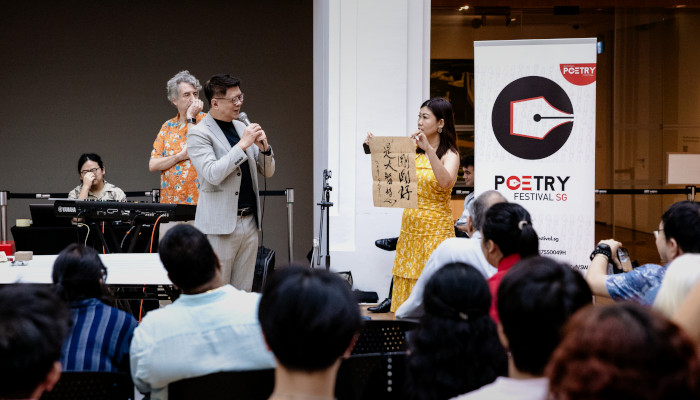
The team’s first major undertaking unfolded at National Gallery Singapore on 28 March 2026 for "Noesis Converse Nation 2," organized by Poetry Festival Singapore and supported by DBS Bank. Marking their very first hands-on experience engaging with public audiences after completing a rigorous 7-class XR training course with Benedict Yu, the LASALLE Arts Management students played a crucial role in introducing the XR project "Echoes of the Bay" to visitors before the main event. During the live XR painting performances—where Benedict Yu translated contemporary poems such as Hong Wee Seng’s “The Forest of Illusion” and Jennifer Leong’s “Seed Re-Generation(s)” into dynamic, spatial visual systems—the students assisted directly with technical setup, audience orientation, and documentation. By managing on-site logistics, capturing key moments, and guiding curious gallery-goers through virtual environments, the student team ensured the audience seamlessly experienced poetry unfolding across scale, temporality, and embodiment.
Roots and Radicals: Reclaiming Neighborhood History at Punggol Coast
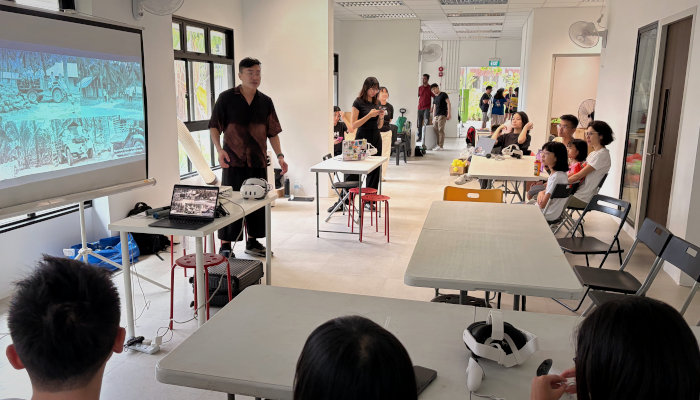
Shifting focus to hyper-local community building, the students facilitated the HAN@Punggol Open House on 14–15 March 2026 at the Singapore Institute of Technology (SIT) Punggol Campus. Presented by OH! Open House and supported by the National Heritage Board (NHB), the initiative aimed to activate local heritage through accessible digital tools. Working under the ground-up collective Punggol Lovers, the arts management cohort led the two-part heritage tour and VR workshop titled "What's Been Livin' in My Hood". Facilitators guided diverse groups, ranging from children aged 7 to 15 to older neighborhood residents, in navigating Meta VR headsets and Open Brush motion tools. Utilizing archival photographs and digital assets provided through NHB's support, students actively taught participants how to engage with these historical materials, empowering them to explore immersive storytelling and digitally recreate scenes of the historic coconut plantations that once covered old Punggol. Overcoming technical glitches and language barriers, the facilitators turned high-tech hardware into a warm, inclusive canvas for shared neighborhood memory.
Palimpsestic Memories: Testing Boundaries at the Arts x Tech Lab
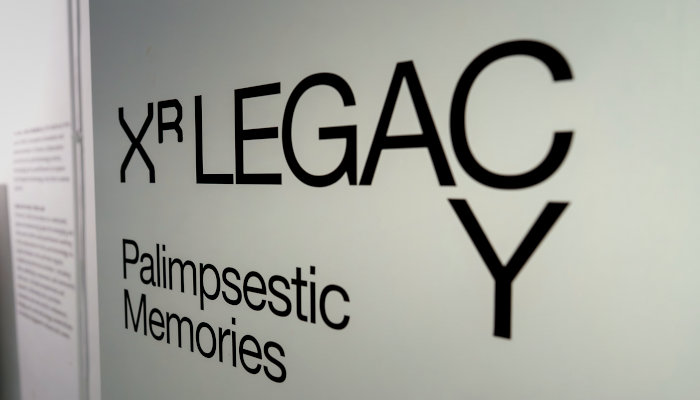
The cohort’s immersive journey culminated in "XR Legacy: Palimpsestic Memories," a comprehensive three-month programme that concluded with a ten-day prototype exhibition from 14–24 August 2026 at Aliwal Arts Centre. Supported by the National Arts Council SG’s Arts x Tech Lab initiative alongside Arts House Group and Aliwal Arts Centre, the project served as an experimental platform to test and question spatial storytelling, performance, and memory. During the initial month, student facilitators assisted local mentors—including Kai Ting Koh, Christopher Chew from Avventura, and Debbie Ding—in delivering foundational workshops that introduced artists to various creative applications of XR. As the programme built toward its public presentation, the student team worked alongside project manager Lisa Park and technical lead Jaime Jover to coordinate an ambitious schedule featuring an opening reception, an online symposium, live XR performances, and an XR Open Jam. Students helped facilitate the ten-day exhibition, guiding over 300 visitors through eight experimental XR works created by Singapore-based artist groups—Clarice Ng, Chen Jiexiao, H. Prakash, Jabez Lim, Joanne Seow, Kimberly Eikaas, WUSHIREN, Siyuan Tong, and Keyue Li—supported by international mentors. Through this extensive engagement, student managers proved essential in bridging the gap between experimental artists, complex technical infrastructure, and the general public.
In Their Own Words: Personal Reflections of the VR Training Programme Graduates
Beyond executing event logistics and mastering hardware, the true impact of the Culture Futures Lab VR training programme lies in the personal and professional growth of the participating students. Moving from initial curiosity to live production, these emerging arts managers developed critical skills in crisis management, cross-cultural communication, public engagement, and technical troubleshooting. In their own words, the graduates reflect below on how stepping onto live VR stages transformed their understanding of creative technology, democratized public art, and shaped their future career paths.
Mastering Chaos: Adaptability and Autonomy on the Live VR Stage by Chan Qing Hao
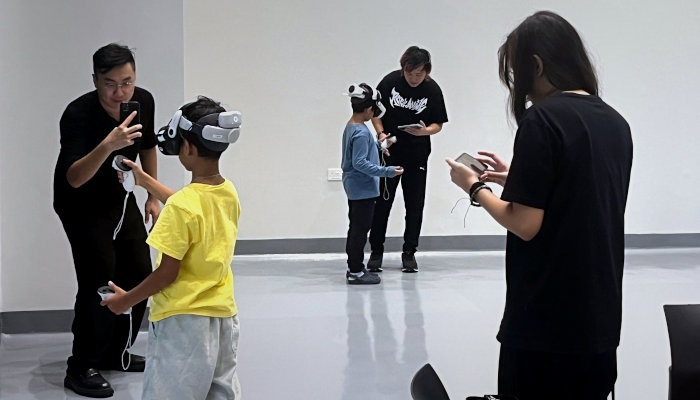
Participating in this year's VR initiatives pushed my role far beyond operating a headset. What began as capturing the National Gallery installation through a photographer’s lens evolved into directing large-scale, live interactive experiences.
Leading the SIT x BENIOS Matcha Rave challenged me to transform high-stakes technical constraints into a seamless visual showcase. Operating independently on-site, I integrated a live XR stream from Austria and engineered our spatial setup using lean equipment—all while directing a facilitation team guiding university crowds through Open Brush. That same adaptability anchored my facilitation across vastly different environments, from running VR heritage tours of old Punggol using archival footage to spontaneously guiding four international groups through 3D art across significant language barriers.
Navigating live technical chaos while keeping first-time users comfortably engaged showed me what creative technology truly demands: staying composed when hardware fails, communicating clearly across cultural barriers, and making complex systems actually work in the room. I walk away with full confidence in my autonomy—knowing I am capable of bridging technical gaps, managing a team, and delivering a live immersive experience from start to finish.
Humanizing Hardware: Connecting Complex Tech with Diverse Audiences by Vina Tan Ding Kiang
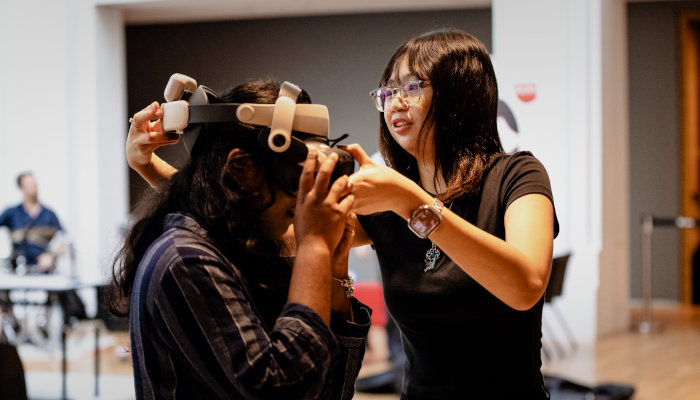
Facilitating XR experiences for a wide spectrum of people forced me to continuously re-evaluate how I communicate complex tech. Whether guiding young children through their first 3D artwork in Open Brush or helping older adults navigate virtual environments, I had to adjust my language on the fly to match each participant’s digital comfort level.
This versatility proved essential across every environment I worked in—from guiding residents through VR heritage tours using archival media at Punggol Coast, to supporting the Poetry Festival Singapore fundraiser at the National Gallery, all the way to representing my institution internationally at Ars Electronica in Linz, Austria.
Dealing with unexpected technical hiccups while keeping first-time users comfortable taught me what working with creative technology actually demands. Learning to stay composed when hardware glitches occur allowed me to bridge the gap between human curiosity and complex systems. I walk away with strong self-assurance in my ability to troubleshoot under pressure, coordinate a team, and bring a live immersive experience to fruition.
From Local Streets to Global Stages: Translating Spatial Narratives by Muhammad Haris Bin Muhammad Shahril
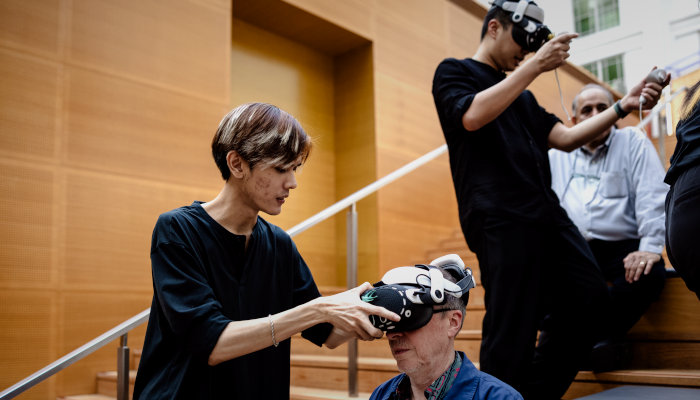
My journey alongside Benedict Yu and LASALLE College of the Arts in this VR landscape has been truly transformative. Entering VR training with no prior background outside of casual gaming, discovering how devices can bridge artistically through the intersection of Arts x Technology was mind-blowing. Witnessing Benedict’s live artistic performance confirmed that I was in the right space.
Assisting with VR facilitation across the National Gallery Singapore for the Poetry Festival, the NAC XR Legacy Project, and Culture Futures Lab allowed me to engage, network, and collaborate directly with multidisciplinary artists. This experience substantially broadened my vision as an upcoming Arts Manager.
Engaging the community through OH! Open House in Punggol demonstrated how spatial XR narratives correlate directly with physical neighborhoods. Subsequently, showcasing these local narratives on a global stage at the Ars Electronica Festival in Austria challenged me to comprehend how hyper-local stories translate into international networks. Working alongside inspiring teams has shaped an unforgettable chapter in my creative development.
Beyond Gallery Walls: Fostering Community and Shared Neighborhood Memory by Sarah Qistina Binte Zaid
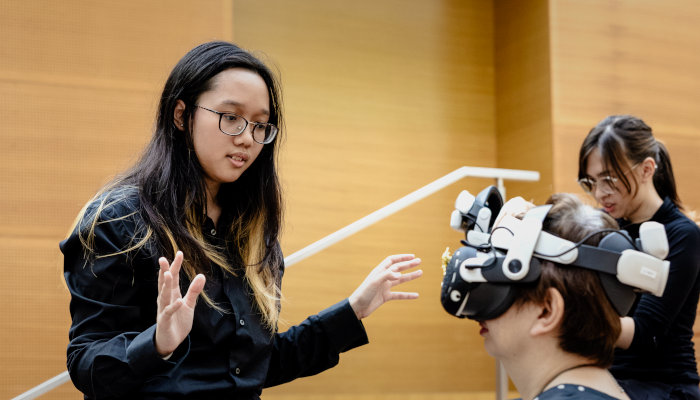
Connecting with residents during the OH! Open House in Punggol was a defining moment in my facilitation journey. While facilitating, I connected deeply with local residents, subtly educating them about Punggol's rich history through VR headsets.
While it is crucial to platform art within established cultural institutions like the National Gallery, we often forget that the most profound aspect of art is its capacity to connect people and foster community. Teaching residents how to utilize Open Brush around their own neighborhood opened many eyes to new digital spaces and possibilities.
Facilitating art technology with BENIOS and supporting partner organizations like Avventura proved that VR is not merely an isolated technological spectacle, but a valuable bridge for community-building and shared memory.
Demystifying XR: Turning Specialized Tech into Accessible Public Art by Malavika Lilani
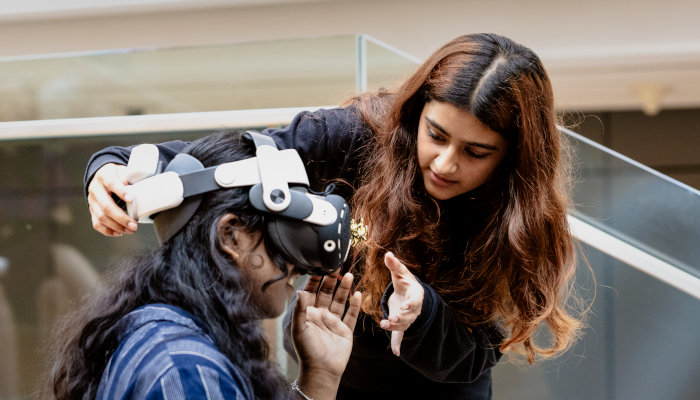
As a VR facilitator, my role centers on introducing diverse audiences to virtual reality: guiding participants through headset navigation, explaining interactive features, and contextualizing the artwork presented.
Facilitating across varied settings—such as the National Gallery for the Poetry Festival, Aliwal Arts House for the XR Legacy Project, and the Singapore Institute of Technology (SIT) for the Matcha Rave—allowed me to engage broad demographics and introduce emerging technologies to non-technical audiences.
These experiences provided a firsthand look at how Extended Reality is evolving from a specialized tool into an accessible medium for mainstream art, social connection, and public engagement. Ultimately, these projects strengthened my public engagement and technical communication skills while highlighting how VR continues to reshape our interactions with digital culture.
Expanding Canvases: Navigating Virtual Worlds as an Emerging Arts Manager by Nina Carmella
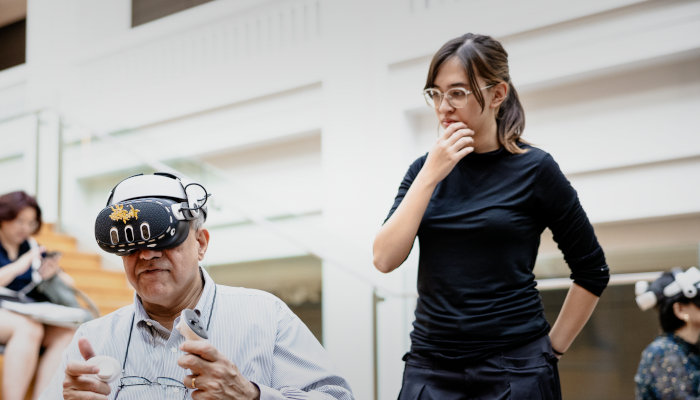
Working alongside Benedict Yu on his initiatives combining art and technology began as a fascinating exploration into the creative possibilities of Open Brush. Guiding young children as they expressed their imagination in virtual space, helping students explore VR as a genuine artistic medium, and enabling gallery visitors to envision art within new landscapes provided an experience entirely beyond my usual realm of art studies.
Furthermore, learning to adapt to diverse audiences visiting exhibitions curated by the XR team proved deeply rewarding. These interactions provided insights that I personally appreciate, helping me refine my passion and expertise within both the art-technology landscape and the broader arts management field.