
Sustainable Fashion Event: Wear It, Share It!
Introduction
The ubiquity of fast fashion has reshaped how people acquire and discard clothing. Online platforms make it effortless to accumulate new garments, while older pieces often linger unused, forgotten in closets. This cycle of excess and neglect underscores a pressing question: how can fashion be reframed not as a disposable commodity, but as a participatory medium for sustainability and community exchange?
Wear It, Share It emerged as a response to this challenge. Rooted in the Project Leader’s personal practice of donating clothes to charities and thrift shops, the initiative sought to create a more accessible, collective avenue for clothing redistribution. Supported by the Young Changemakers Grant from the National Youth Council and LASALLE College of the Arts’ School of Creative Industries, the project was implemented as a multidimensional event that combined fashion with art and craft to spark dialogue on ecological responsibility.
Presenting Fashion as a Shared Ecology
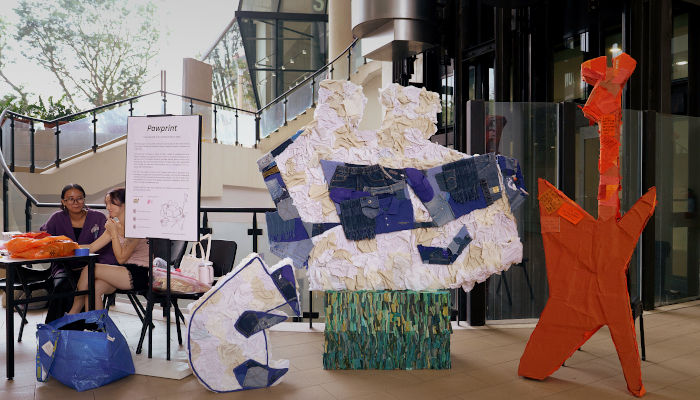
The project was presented as a triptych of experiences, each designed to highlight a different dimension of sustainable practice:
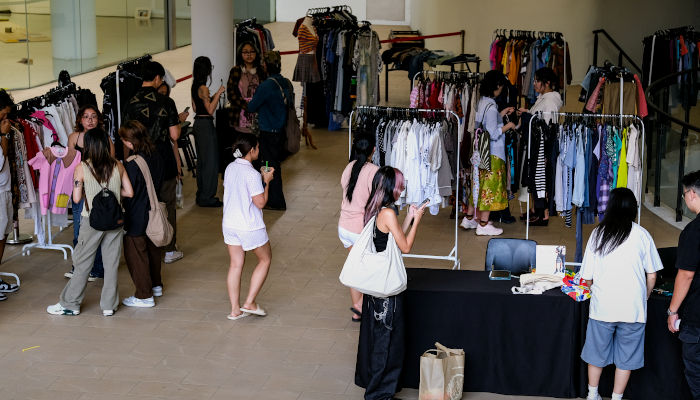
Clothes Swap: Partnering with The Fashion Pulpit, the event invited participants to exchange garments, refresh their wardrobes and donate surplus clothing. With 1,000 curated pieces provided, the swap became a lively marketplace of circulation, where fashion was re‑contextualised as shared resource rather than private possession.
Pawprint Art Installation: In collaboration with Fashion Parade, recycled fabric and cardboard were transformed into an interactive artwork. Visitors could touch the installation and inscribe personal pledges, turning the piece into a collective record of commitment toward sustainability.
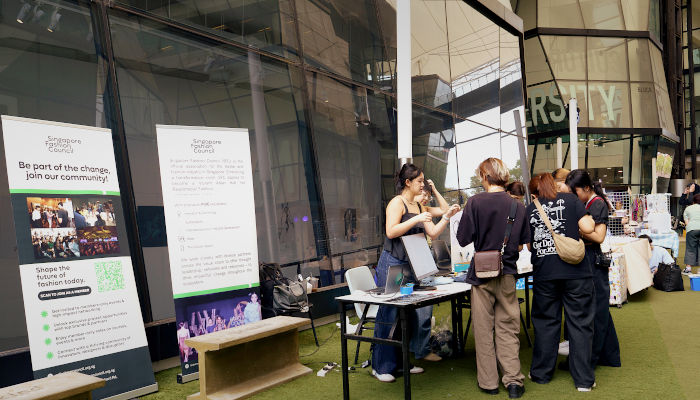
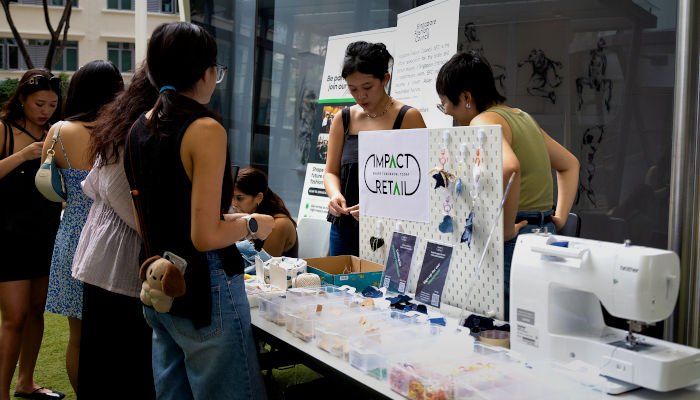
Denim Keychain Workshop: Facilitated by the Singapore Fashion Council, this booth encouraged participants to repurpose old denim into functional accessories. The act of crafting reinforced the message that sustainability can be embedded in everyday creativity.
Together, these components articulated a framework where fashion operates simultaneously as utility, symbol and catalyst for change.
Participation as Transformation
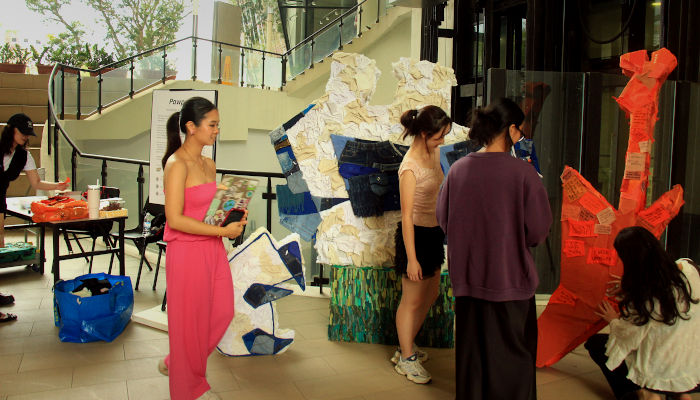
The methodology of Wear It, Share It was rooted in the belief that sustainability is not a spectator sport; it requires a transition from passive consumption to active agency. By moving beyond abstract environmental advocacy, the project invited audiences to engage in "material storytelling" through tangible gestures—swapping, touching, pledging, and crafting. This participatory framework served as a metamorphic engine, effectively transforming perceived waste into renewed value.
Within this space, a forgotten garment was not merely "old," but a catalyst for a new encounter. Discarded fabric was elevated from refuse to the status of a collective art installation, while worn denim was reimagined as a functional keep-sake. By embedding these hands-on activities within the event design, the project demonstrated that the "arts manager" does more than organise—they curate the conditions for a shift in consciousness. This approach translated complex ecological discourse into a live, embodied practice, making the daunting concept of sustainability accessible and desirable to a diverse public.
Impact and Outcomes
Presented alongside LASALLE’s Rock and Indie Festival 2026, the initiative reached a broad demographic of youth, industry professionals, influencers and various cultural stakeholders. The event space encouraged fluid movement between activities, allowing participants to experience sustainability through multiple entry points. Observations revealed high levels of engagement, with visitors not only participating but also reflecting on their own consumption habits.
The involvement of professional partners lent credibility and sector resonance, while the festival context amplified visibility and accessibility. The project’s interactive design ensured that sustainability was not a distant concept, but a shared, embodied experience.
The initiative achieved tangible results that underscore its ecological and social value. Over the course of the event, Wear It, Share It collected 55 kilograms of clothing for donation to the Red Cross Singapore. In total, the project saved 85 kilograms of clothes from potential waste, translating into an estimated 2.9 tonnes of CO₂ emissions avoided. These figures highlight how participatory curation can generate measurable environmental benefits while fostering community solidarity.
The installation Pawprint continues to extend the project’s reach. It is currently on display at the Ngee Ann Kongsi Library until April 1st, offering ongoing opportunities for audiences to engage with its ecological symbolism beyond the festival context.
Conclusion: The Architecture of Change
Wear It, Share It serves as a definitive case study in how arts management functions as a generative, socially-engaged practice. By intersecting logistical strategy with ecological responsibility, the initiative moved beyond the traditional "showcase" to create a living ecosystem of exchange. It advanced a core thesis: that sustainability reaches its highest potential when it is enacted collectively rather than practiced in isolation.
- Collective Action: Fashion swaps as accessible models for reducing waste.
- Artistic Reflection: Installations as tools for dialogue and activism.
- Creative Repurposing: Craft workshops as pathways to embed sustainability in daily life.
Through the Clothes Swap, fashion was redefined as a shared resource; through the Pawprint Installation, artistic reflection became a tool for public activism; and through Creative Repurposing, craft workshops provided practical pathways to embed sustainability into the fabric of daily life. The project proved that the framework surrounding an event—the "how" of the encounter—is just as creative as the objects within it. Ultimately, by curating a space where exchange, reflection, and creation converge, Wear It, Share It offers a forward-looking model for participatory sustainability that successfully bridges the gap between fashion, art, and community practice.
Participants
Coordinator: Michelle Loh
Project Head: Daniel Antonio D'souza
Project Team:
- Logistics Officer: Aria Nichani
- Marketing Officer: Sri Nor Wakhidatun Nazila
- Marketing Officer: Minerva Chia
Project Partners: Fashion Parade, Singapore Fashion Council, The Fashion Pulpit
Pawprint Creative Designer: Nina Carmella Laita Go
Volunteers: Alison Schooling, Amirah Lestari, Benedict Setiawan, Chen Si-Yu (Annabelle), Dian Suhadi, Dylan Koh, Haruka Chia, Khoo Jing Wen (Audrey), Lee Jie Yee, Raisza Rinaldi, Samuel Gay
Special Thanks to: Dr Malar Villi Nadeson, Erzan Adam, Zelfi Chung, Nurin Zahirah Bte Zakaria